NEUE ALTE KIRCHE
Vordere Kirchgasse 6
78591 Durchhausen
48.0371° N · 8.6642° O
Kulturdenkmal (DSchG BW)
Saalbau mit Polygonalchor
Dachwerk 17./18. Jh., stützenfrei
Listed monument (DSchG BW)
Aisleless nave, polygonal choir
17th/18th-c. roof, free-spanning
Fläche im Haus ≈ 400 m²
Gebot: 155.000 €
Vorgelegt an Familie Faitsch
Floor area ≈ 400 m²
Bid: €155,000
Submitted to the Faitsch family
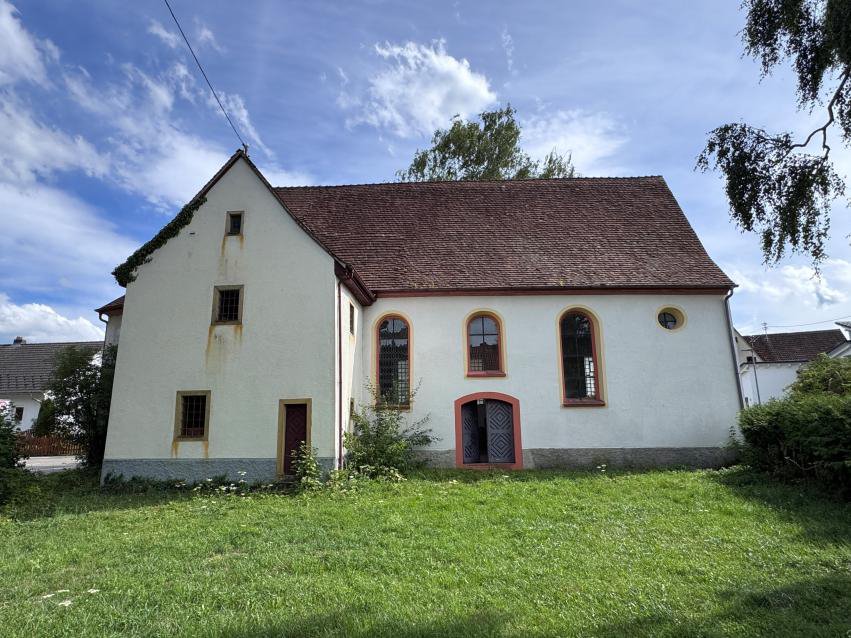
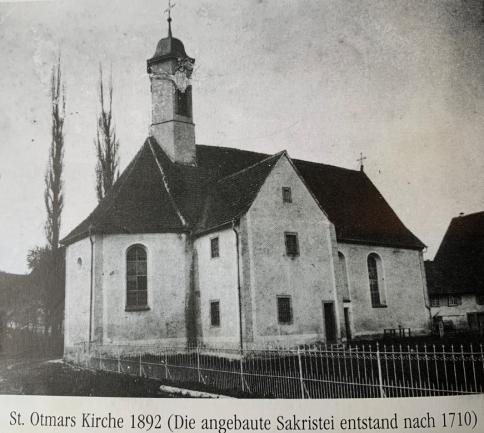
Es gibt Häuser, die verkauft werden, und Häuser, die anvertraut werden. St. Otmar gehört zur zweiten Sorte: 1624 gebaut, 1958 entweiht, 1981 fast abgerissen, 1994 gerettet. Wer dieses Haus übernimmt, übernimmt keine Immobilie, sondern eine Verantwortung, die älter ist als jedes Grundbuch.
Dieses Konzept teilt das Haus nicht in Quadratmeter, sondern in drei gleichwertige Leben: Wohnen für fünf kleine Haushalte unter dem alten Dach — drei im Mittelgeschoss, zwei im Dachspitz. Arbeit für die Kunst. Offenheit für alle, im Saal wie im Garten. Ein Drittel, ein Drittel, ein Drittel — im Gleichgewicht wie eine Schallplatte bei 33⅓ Umdrehungen.
Die folgenden Kapitel erzählen, belegen und rechnen. Erzählt wird für alle, belegt für das Denkmalamt, gerechnet für die Bank. Entschieden aber wird — hoffentlich — mit dem Herzen: von der Familie, die dieses Haus seit 1994 hütet.
Some houses are sold; others are entrusted. St. Otmar belongs to the second kind: built in 1624, deconsecrated in 1958, nearly demolished in 1981, rescued in 1994. Whoever takes it on inherits not a property but a responsibility older than any land register.
This concept divides the house not into square metres but into three equal lives: homes for five small households under the old roof — three on the middle level, two in the roof peak. Work for art. Openness for everyone, in the hall as in the garden. One third, one third, one third — balanced like a record at 33⅓ rpm.
The chapters that follow narrate, substantiate and calculate. Narrated for everyone, substantiated for the heritage office, calculated for the bank. But the decision, hopefully, is made with the heart — by the family that has kept this house since 1994.
Der Bestand ist keine Last.
Er ist das Kapital.
The fabric is not a burden.
It is the capital.
Er ist das Kapital.
It is the capital.
Neun Meter fünfzig mal vierundzwanzig. Ein Saal, in dem 130 Quadratmeter von nichts verstellt werden. Ein Dachwerk, das seit drei Jahrhunderten ohne Stütze über allem spannt. Mauerwerk und Dachkonstruktion sind in dem Alter entsprechend sehr gutem Zustand; West- und Nordseite wurden 1993 saniert. Alle Anschlüsse liegen im Grundstück.
Nine and a half metres by twenty-four. A hall in which 130 square metres are obstructed by nothing. A roof structure spanning free of columns for three centuries. Masonry and roof are in very good condition for their age; the west and north sides were repaired in 1993. All utilities are on site.
33⅓
33⅓ ist keine Zahl aus der Tabellenkalkulation, sondern eine Haltung: Kein Nutzen dominiert, keiner wird wegsubventioniert. Saal und Garten gehören dem Dorf, die Empore der Kunst, das Dach dem Leben — fünf kleine Zuhause auf zwei Ebenen. Drittel meint Gewicht, nicht Zentimeter.
Und ja — 33⅓ ist auch die Drehzahl einer Langspielplatte. Wer ein Drittel seines Lebens elektronische Musik produziert, nimmt das als gutes Omen: Dieses Haus läuft nicht auf 45. Es läuft langsam, warm und lange.
33⅓ is not a spreadsheet figure but an attitude: no use dominates, none gets subsidised away. Hall and garden belong to the village, the gallery to art, the roof to living — five small homes on two levels. A third means weight, not centimetres.
And yes — 33⅓ is also the speed of a long-playing record. Someone who spends a third of his life producing electronic music takes that as a good omen: this house does not run at 45. It runs slow, warm and long.
Alles Neue steht im Alten —
eingestellt, ablesbar, rückbaubar.
Everything new stands inside the old —
inserted, legible, removable.
eingestellt, ablesbar, rückbaubar.
inserted, legible, removable.
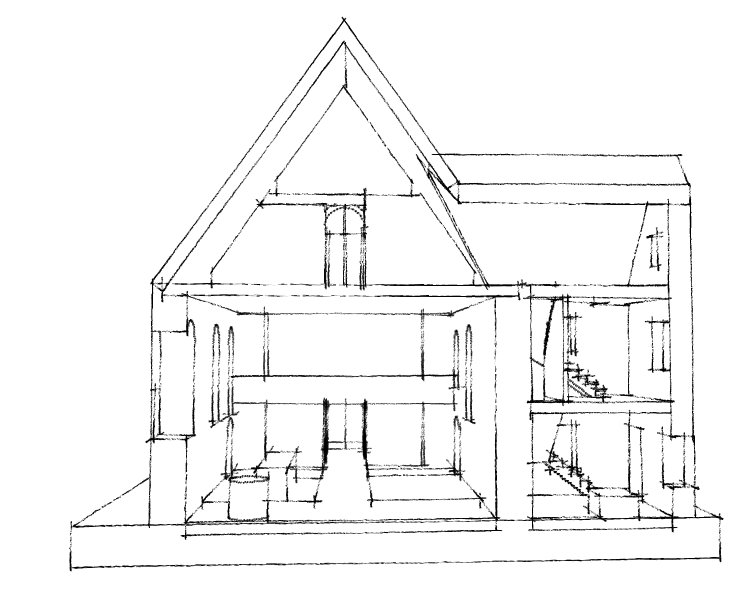
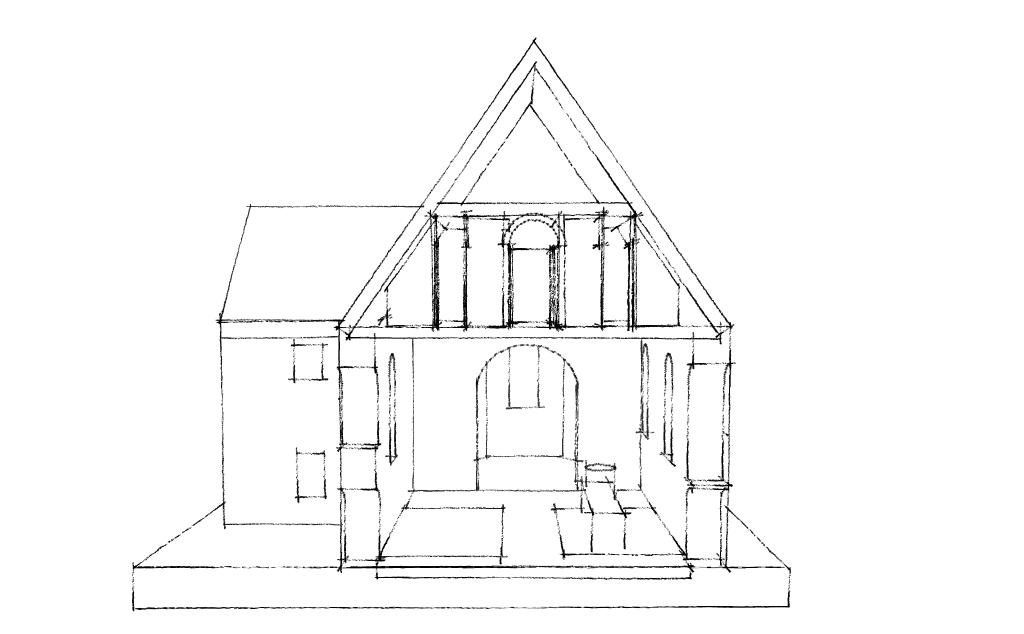
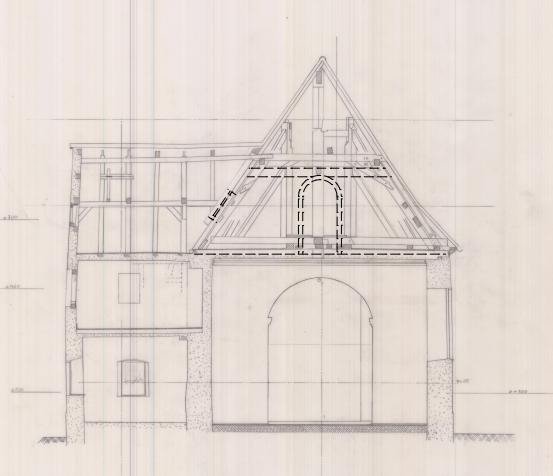
Der Regler zeigt, wie wenig sich das Haus ändern muss, um drei Leben zu tragen: Empore und zwei Wohnebenen — drei Wohnungen im Mittelgeschoss, zwei Einheiten im Dachspitz — werden als Haus im Haus eingestellt, der aufgeschüttete Boden kehrt auf sein Originalniveau zurück, das Südportal öffnet sich wieder zum Platz. Die Hülle von 1624 bleibt, was sie ist.
The slider shows how little the house must change to carry three lives: the gallery and two living levels — three apartments on the middle level, two units in the roof peak — are inserted as a house within the house, the raised floor returns to its original level, the south portal reopens onto the square. The 1624 shell remains what it is.
{{ txtLegendeHint }}
{{ activeThird.claim }}
Nichts hier widerspricht dem Ortstermin.
Vieles ist wörtlich daraus gebaut.
Nothing here contradicts the site meeting.
Much of it is built verbatim from it.
Vieles ist wörtlich daraus gebaut.
Much of it is built verbatim from it.
Am 20. November 2025 trafen sich Eigentümer, Landesamt für Denkmalpflege und Baurechtsamt Trossingen vor Ort (Aktenvermerk 607-112671). Dieses Konzept übernimmt die dort abgesteckten Spielräume eins zu eins — es beginnt nicht bei null, sondern auf genehmigungsnahem Terrain.
On 20 November 2025 the owner, the State Heritage Office and the Trossingen building authority met on site (memo 607-112671). This concept adopts the parameters staked out there one to one — it does not start from zero, but on near-approvable ground.
Ob ein Raum trägt, hört man.
Und man sieht es dämmern.
Whether a room carries, you hear.
And you watch it turn to dusk.
Und man sieht es dämmern.
And you watch it turn to dusk.
Sechs Rundbogenfenster führen die Sonne einmal quer durchs Schiff — morgens in den Chor, mittags über den Steinboden, abends auf die Empore. Der Regler durchläuft einen Tag. Der Klangbaustein deutet an, was 5,50 Meter Raumhöhe mit einem Ton machen.
Six round-arched windows walk the sun across the nave — into the choir at dawn, over the stone floor at noon, onto the gallery at dusk. The slider runs through one day. The sound module hints at what 5.5 metres of height do to a tone.
{{ txtKlangNote }}
Die Kirche bleibt im Dorf.
Und das Dorf darf in die Kirche.
The church stays in the village.
And the village may enter the church.
Und das Dorf darf in die Kirche.
And the village may enter the church.
Kein Museum, keine Eventhalle: ein verlässlich offener Raum für Glaube und Musik — in Abstimmung mit Kirchengemeinde und Gemeinde Durchhausen, unentgeltlich für das Dorf. Der Chor wird Raum der Stille, täglich offen, ohne Eintritt, ohne Bekenntnis.
Not a museum, not an event hall: a reliably open room for faith and music — coordinated with the parish and the municipality of Durchhausen, free of charge for the village. The choir becomes a room of silence, open daily, no ticket, no creed.
700 m² Begegnung
unter freiem Himmel.
700 m² of encounter
under the open sky.
unter freiem Himmel.
under the open sky.
Die Gebhardt-Studie wünscht sich eine „dem Ort angemessene Freianlage“ — hier ist sie: kein Zierrasen, sondern ein nutzbarer Gemeinschaftsgarten. Hochbeete zum Mitgärtnern, eine lange Tafel unter den Bäumen und eine kleine Bühne am Haus — alles reversibel gestellt, nichts gegründet, offen für Dorf und Vereine.
The Gebhardt study calls for grounds “appropriate to the place” — here they are: no ornamental lawn but a usable community garden. Raised beds for shared gardening, a long table under the trees and a small stage by the house — everything reversibly placed, nothing founded, open to village and clubs.
Vom Handschlag zur Einzugsfeier:
vier Monate, zehn Schritte.
From handshake to housewarming:
four months, ten steps.
vier Monate, zehn Schritte.
four months, ten steps.
Sehr geehrter Herr Joachim Faitsch, sehr geehrter Herr Roland Faitsch,
Sie haben dieses Haus 1994 gekauft, als es kaum jemand wollte, und ihm seither das Dach über dem Kopf gehalten — im wörtlichsten Sinn. „Kulturdenkmäler retten und beleben“ ist Ihr Satz. Die Rettung ist Ihr Verdienst. Um die Belebung bewerbe ich mich hiermit.
Mein Gebot liegt bei 155.000 Euro — deutlich über dem Mindestgebot. Nicht als Verhandlungstaktik, sondern weil Ernsthaftigkeit sich beziffern lassen muss, wenn man um ein Haus wirbt, das nicht dem Meistbietenden, sondern dem besten Konzept versprochen ist.
Drei Bitten habe ich. Erstens: Begleiten Sie die Restaurierung — Ihr Büro für Bauforschung und Denkmalpflege kennt jede Fuge dieses Hauses, und Ihr Angebot dazu nehme ich an, bevor Sie es aussprechen. Zweitens: Die Vorstudien von Büro Gebhardt werden nicht verworfen, sondern fortgeschrieben. Drittens: Feiern Sie mit, wenn Ende Oktober Einzug ist — und bleiben Sie die Ersten, die durch die Tür kommen, wann immer der Saal offen steht.
Der Tag des offenen Denkmals bleibt. Der Otmar-Tag am 16. November kommt dazu. Die Kirche bleibt im Dorf — sie schläft nur nicht mehr.
Mit großem Respekt vor dreißig Jahren Hüterschaft,
Dear Mr Joachim Faitsch, dear Mr Roland Faitsch,
You bought this house in 1994, when hardly anyone wanted it, and have kept a roof over its head ever since — in the most literal sense. “Rescuing and reviving cultural monuments” is your phrase. The rescue is your achievement. I hereby apply for the revival.
My bid is €155,000 — well above the minimum. Not as a negotiating tactic, but because seriousness must be quantifiable when one courts a house promised not to the highest bidder but to the best concept.
I have three requests. First: accompany the restoration — your office for building research and conservation knows every joint of this house, and I accept your offer before you make it. Second: the preliminary studies by Büro Gebhardt will not be discarded but continued. Third: celebrate with us at the housewarming in late October — and remain the first through the door whenever the hall stands open.
Heritage Open Day stays. St. Otmar’s Day, 16 November, is added. The church stays in the village — it simply no longer sleeps.
With great respect for thirty years of guardianship,
{{ txtBankH }}
In Kontakt
treten.
Get in
touch.
treten.
touch.
{{ kontaktEmail }}
Vordere Kirchgasse 6
78591 Durchhausen
Zuschlag erhofft: August 2026
Einzugsfeier: Ende Oktober 2026
Award hoped for: August 2026
Housewarming: late October 2026